


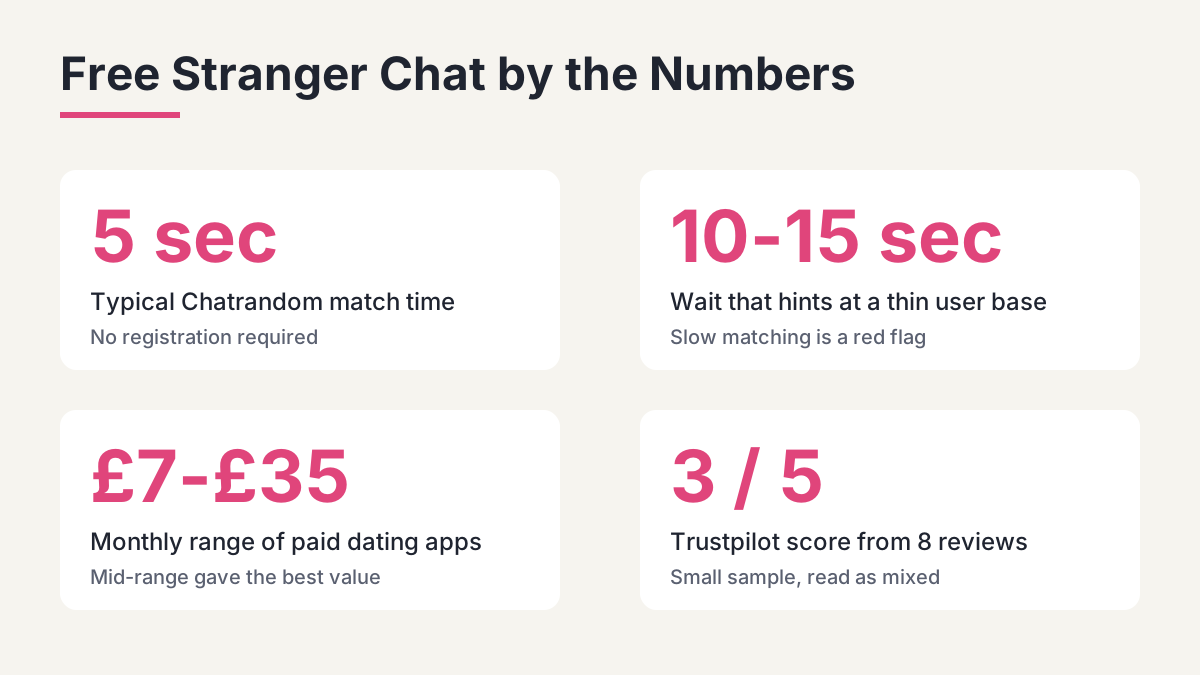
Most free chat with strangers sites look identical on the landing page: one button, a promise of instant matching, and a counter of people online. Chatrandom matches users within about 5 seconds and requires no registration at all. That speed is the baseline now. What separates one site from another is what happens in the 30 seconds after the match, when a stranger either behaves or does not.
This comparison looks at the criteria that decide whether a session is worth your time: moderation, anonymity, cost, device support and how easy it is to leave a bad chat. It also covers the risks that free platforms rarely advertise, using the vertical's known problem areas rather than guesswork.
How free chat with strangers sites actually make money
Free does not mean costless to run. According to research into dating and chat platforms, the typical monetisation models are freemium upgrades, subscription tiers, in-app purchases and advertising shown to free users. Anonymous random chat sites lean mostly on advertising and optional paid filters, because there is no profile data to sell premium matching on.
This matters for you in practical ways. A site funded by ads has an incentive to keep you clicking "next", not to keep you in a good conversation. A site that sells paid filters, such as gender or country selection, tends to hold back those filters from free users. Chatrandom is free to use with no login, so the free tier is genuinely usable, but you should still expect ads and prompts to upgrade.
Compare that with registration-based dating apps, where subscription cost is the main barrier. When I was evaluating whether a paid subscription was worth it in April, I compared the features across three platforms side by side. Prices ranged from around 7 pounds to nearly 35 pounds per month. The mid-range option gave the best mix of safety features and messaging tools, and people I spoke to in London kept pointing to value over price. Data from those conversations suggested users who pay for at least one premium feature report higher satisfaction, and that matched my experience after upgrading. Random chat sites are a different product, but the lesson carries over: the cheapest option is rarely the one with the best controls.
What to compare before you pick a site
Four factors do most of the work. The first is matching speed. Waiting more than 10 or 15 seconds usually means a thin user base in your region. The second is moderation: does the site publish community guidelines, offer a report button, and say what happens after a report? The third is anonymity: can you chat without handing over an email address or social login? The fourth is exit control, meaning how quickly you can skip a chat without friction.
Chatrandom publishes community guidelines and terms of service, offers reporting tools and states that data is encrypted. It also has text and video options, plus a live video feature called Chat Random TV. You can read our longer assessment in the Chatrandom review, which covers how these features behave in practice.
Statistics on user preference point the same way. Surveys of UK singles regularly show that verification and moderation rank above price when people choose a platform. On anonymous sites there is little verification to speak of, so moderation and reporting carry almost all the safety load.
Text chat versus video chat
Text-only sites such as the ones ranking in the top results trade intimacy for safety. You reveal nothing visual, so a bad match costs you nothing but a click. Video sites add more human connection but also more exposure. Explicit content is the single most common complaint on random video platforms, and moderation can only react after the fact on a live stream.
If you are new to this, start with text. It lets you judge a platform's culture, how many bots appear and how quickly strangers get hostile, before you switch your camera on. When you do move to video, cover anything identifying in your background, such as post, uniform badges or a window with a recognisable street view. Chatrandom works through mobile browsers on phones, though it has no dedicated app, so permissions are handled by your browser and are easy to revoke.
The risks free sites rarely mention
The vertical's documented problem list is consistent. Fake profiles and bots top it: automated accounts send spam links, and scammers push conversations off-platform to WhatsApp or Telegram within minutes. Romance scams and extortion attempts follow the same pattern, with an early request to move chats elsewhere and a reluctance to show a live face.
Chatrandom's own known issues are worth stating plainly. Users report encountering explicit or inappropriate content despite moderation, abusive behaviour in a minority of chats, and some fake profiles or bots. There is no mobile app. Our tracking of the Trustpilot listing shows a score of 3 across 8 reviews since 2026-08-31, which is a very small sample and should be read as mixed rather than conclusive. For a fuller breakdown of the recurring themes, see our page on Chatrandom complaints.
None of this is unique to one site. It is the cost of anonymity. A platform with no sign-up cannot verify age or identity, so it cannot keep out every bad actor. That trade-off is why the free tier is open to everyone and why you carry more of the responsibility yourself.
A practical safety routine
A few habits remove most of the risk. Never share your surname, workplace, address, phone number or social handles. Treat any request for money, gifts or a move to another app as a stop sign, because that is the standard scam sequence. Use the report tool on anyone who breaks the guidelines, since reports are the main signal moderators act on.
Keep your session short at first. Ten minutes of testing tells you more about a site's culture than any review. If you want to understand the platform's safeguards in detail, our guide on whether Chatrandom is safe walks through reporting, encryption and age rules. The platform is intended for adults aged 18 and over. It is not suitable for children, and parents should block it on shared devices.
Where Chatrandom fits among its alternatives
The usual comparison set includes Omegle-style sites, Chatroulette, Shagle, Emerald Chat, OmeTV and Joingy. They share the same core idea, so differences come down to detail. Some add gender or country filters behind a paywall. Some require a login. Some lean on text, others on video. Chatrandom's distinguishing points are zero registration, a stated 5-second match time and a global user base.
If you want a camera-first experience with filtering, Shagle sits in the same family of services and is worth testing alongside it, though the same caveats about anonymity apply. In comparison, text-only sites win on low exposure, and registration-based apps win on verification. No single option wins on everything, which is why matching the tool to your goal matters more than picking a name.
Language practice is a good example. If you want to practise a second language, a text site with country filters beats a video site, because you can take your time and nothing is recorded visually. For casual conversation or meeting people across time zones, video suits better. For dating in the traditional sense, an app with photo verification and a profile history is the more sensible route, because anonymous chat is built for fleeting contact, not for building a relationship.
Reading the signals during a chat
You can often judge a chat in the first minute. Genuine users answer questions with specifics and tolerate small talk. Bots reply instantly with identical phrasing, drop a link early or steer towards another platform. Scammers show a pattern: flattery within a few messages, a sudden personal story, then a request. Close the chat the moment you see it.
Account handling is another quiet signal. Because Chatrandom needs no sign-up, there is little account data to manage, though our notes on the Chatrandom account cover what changes if you choose to register for extra features. The less you hand over, the less there is to lose, which is the real advantage of the no-registration model.
Comments
No comments yet.
Leave a comment
Your email will not be shown. Comments are reviewed before they appear.